
Artificial intelligence has become one of the quiet helpers we now depend on without thinking twice. It suggests what we should watch, helps us find faster routes, filters spam, and keeps complex systems running in the background. In business, it plays the same role. It supports forecasting in finance, reduces waste in operations, and handles routine conversations in customer support. Yet despite how present it has become, many leaders still stop at the same point. What is AI really, and what is artificial intelligence AI when it comes to solving real business problems?
This guide is shaped by practical curiosity rather than hype. It looks at where AI delivers, where it doesn’t, and why that difference matters. The aim is to move past abstract definitions and focus on how artificial intelligence shows up in everyday decisions, systems, and workflows that have to work, not just sound impressive.
Defining artificial intelligence in simple terms
At a basic level, artificial intelligence refers to systems that can perform tasks normally requiring human judgment. These include recognising patterns, learning from data, understanding language, and supporting decisions. When people ask what artificial intelligence or AI is, they are often looking for a single definition. In practice, AI is not one thing. It is a collection of techniques used to solve different types of problems.
From a business perspective, AI is best understood as a way to extend human capability. It handles large volumes of data quickly and consistently. It does not replace expertise. It supports it. That distinction matters more than most technical definitions.
Why AI suddenly feels unavoidable
AI has existed for decades, but only recently became widely useful. Early systems relied on fixed rules. They worked well in narrow situations and failed as soon as conditions changed. The shift came when systems began learning directly from data instead of relying on rigid instructions.
Three forces pushed AI into the mainstream. Data became abundant. Computing power became cheaper. Algorithms improved. Together, these changes made AI practical rather than experimental. What is AI today, looks very different from what it was even ten years ago.
The core components of AI
Most modern AI systems rely on three elements. Data, models, and feedback. Data is the foundation. Poor data leads to poor outcomes. Models are mathematical tools that find patterns within that data. Feedback allows systems to improve over time by learning from results. This ability to adapt is what separates AI from traditional software.
In real organisations, AI rarely exists on its own. It is usually embedded into existing platforms such as analytics tools, CRM systems, or operational dashboards.
Machine learning and executive relevance
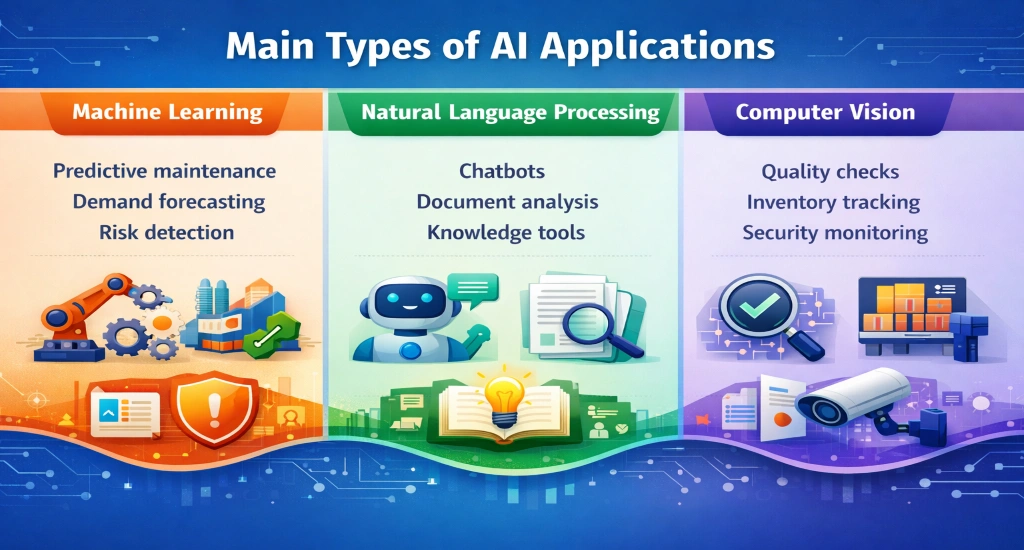
Machine learning is a subset of artificial intelligence that allows systems to improve through experience. For leaders asking what is AI in operational terms, machine learning is often the most visible part.
It powers demand forecasting, risk detection, predictive maintenance, and recommendation engines. A logistics firm might use it to predict delays. A finance team might use it to flag unusual transactions. These systems do not make final decisions. They surface insights that guide human judgment.
Language based AI in everyday operations
Natural language processing allows AI systems to work with human language. It supports chatbots, document analysis, and internal knowledge tools. When leaders wonder what artificial intelligence (AI) is doing inside customer service or compliance teams, language models are often involved.
When designed well, these tools reduce response times and standardise outputs. When designed poorly, they frustrate users. The difference usually comes down to training data quality and clear boundaries around when humans step in.
Computer vision enables machines to make sense of images and video. You see it in factory quality checks, retail stock tracking, and security systems. It works best in settings where speed and consistency matter more than human judgement.
For organisations evaluating what is AI worth investing in, computer vision often delivers clear returns in operational environments.
Automation is not always intelligence
A common misunderstanding is that all automation equals AI. Many automated systems follow fixed rules and never learn. AI driven automation adapts based on outcomes.
This difference matters. Rule based automation improves efficiency. AI based automation improves adaptability. Both matter, but they serve different roles and demand different levels of oversight.
Where AI creates real advantage
AI delivers the most value when it amplifies existing strengths. Companies with strong data assets or deep domain expertise gain more from AI than those chasing novelty.
Key benefits include consistency, speed, and insight. AI applies logic evenly across thousands of decisions. It processes information faster than human teams. It reveals patterns that manual analysis misses.
For leadership teams asking what is AI capable of delivering, the better question is where it removes friction or sharpens decision making.
Reducing repetitive work without losing control
One of the strongest use cases for AI is handling repetitive tasks. Tasks like report creation, validating data, classifying tickets, and keeping an eye on systems can be automated. Done right, AI does the heavy lifting, freeing skilled staff for more meaningful work. When it works well, teams get back hours to focus on higher-impact tasks. Oversight still matters. Effective organisations define clear accountability and review mechanisms so automation supports decisions rather than obscuring them.
Limitations worth taking seriously
AI systems reflect their training data. Any gaps, errors, or skewed data make their way into the outcomes. AI also struggles outside its training context. It does not understand intent or ethics in the way humans do.
There are real organisational risks. Lax governance leads to compliance gaps, brittle systems, and eroded trust. AI should be treated strategically rather than as disconnected tools.

Regulation and trust in the UK and Europe
In the UK and Europe, adopting AI is heavily influenced by strict data protection laws and the way regulations are evolving. Transparency and accountability are quickly becoming baseline expectations. If interested, you can read about the UK AI regulation and data protection in detail.
When exploring what artificial intelligence AI fits a particular use case, companies need to consider more than just technical feasibility. Reputation, compliance, and trust all matter. AI should build confidence, not chip away at it.
Companies exploring what is artificial intelligence AI appropriate for their use case must consider more than technical feasibility. Trust, reputation, and compliance all play a role. AI should strengthen confidence, not undermine it.
Choosing an AI approach that fits
Some organisations build AI systems in house. Others rely on external platforms. Many choose a hybrid path. The right choice depends on data sensitivity, internal skills, and long term goals.
A practical starting point is identifying processes where decisions depend heavily on data and volume. Small pilot projects test assumptions and build confidence before scaling further.
AI as an ongoing capability
Successful organisations treat AI as something that evolves.Models require monitoring. Data pipelines need care. Business conditions change.
AI delivers long term value when companies invest in people, governance, and learning. It becomes an asset that improves over time rather than a one off project. Looking ahead
AI is becoming less visible and more embedded. It will sit inside everyday tools rather than stand apart as a separate system. Decision support will feel more natural.Automation will become more contextual.
For anyone still wondering what is AI or what is artificial intelligence in the context of future competitiveness, the key is integration, not replacement. AI will not replace leadership or strategy. It will reshape how they are executed. If you want to find out about top free AI tools that can help you on a daily basis,
Final perspective
Artificial intelligence is neither a shortcut nor a threat. It is a powerful set of tools that, when used thoughtfully, reshapes how organisations operate.